Caffeine Is Destroying Your Sleep. Paraxanthine Doesn't Have To.
Most people think they understand caffeine. Drink coffee, get stimulated, crash later. Simple.
It isn't.
What we call "caffeine" is actually a two-stage pharmacological relay, and most of the effect people like doesn't come from caffeine itself at all. It comes from its primary metabolite: paraxanthine.
Once you see how this works—and do the half-life math—you'll understand why caffeine is far worse for sleep than anyone realizes. And why I switched.
The Half-Life Lie
You've probably heard that caffeine has a half-life of 5-6 hours. That sounds manageable, right? Have coffee at 2pm, and by 8pm it's down to 25%. By midnight, negligible. Sleep fine.
This is wrong. And not in a "well, actually it varies by person" way. It's wrong at the level of basic pharmacology.
Here's what that 5-6 hour number actually means: it's the time for caffeine to be converted into its metabolites. Not eliminated. Converted.
And here's the problem: the primary metabolite is more potent than caffeine itself.
When caffeine hits your liver, CYP1A2 enzymes break it down into three compounds:
- ~80% → Paraxanthine (1,7-dimethylxanthine)
- ~10–15% → Theobromine
- ~5–10% → Theophylline
Paraxanthine has higher affinity for adenosine A1 and A2A receptors than caffeine. Per molecule, it's a stronger stimulant. So when people talk about caffeine's half-life, they're describing the conversion of a weaker stimulant into a stronger one.
And each metabolite has its own half-life:
| Compound | Half-Life | Notes |
|---|---|---|
| Paraxanthine | 3.1 hours | More potent than caffeine at adenosine receptors |
| Caffeine | 4.1 hours | The parent compound |
| Theobromine | 6.2 hours | Lingers longest |
| Theophylline | 7.2 hours | Also a prescription bronchodilator |
So the real picture is:
- You drink coffee at 2pm
- Caffeine peaks at ~3pm
- By 7pm, caffeine is "half gone"—but you've now generated a large pool of paraxanthine, which is peaking right now
- Plus theophylline and theobromine, which will persist past midnight
The stimulant signal at hour 5 is often higher than at hour 1. You haven't eliminated anything. You've transformed it.
The Math: What's Actually In Your Blood
Let me walk through this with actual curves. Here's what happens when you take caffeine:
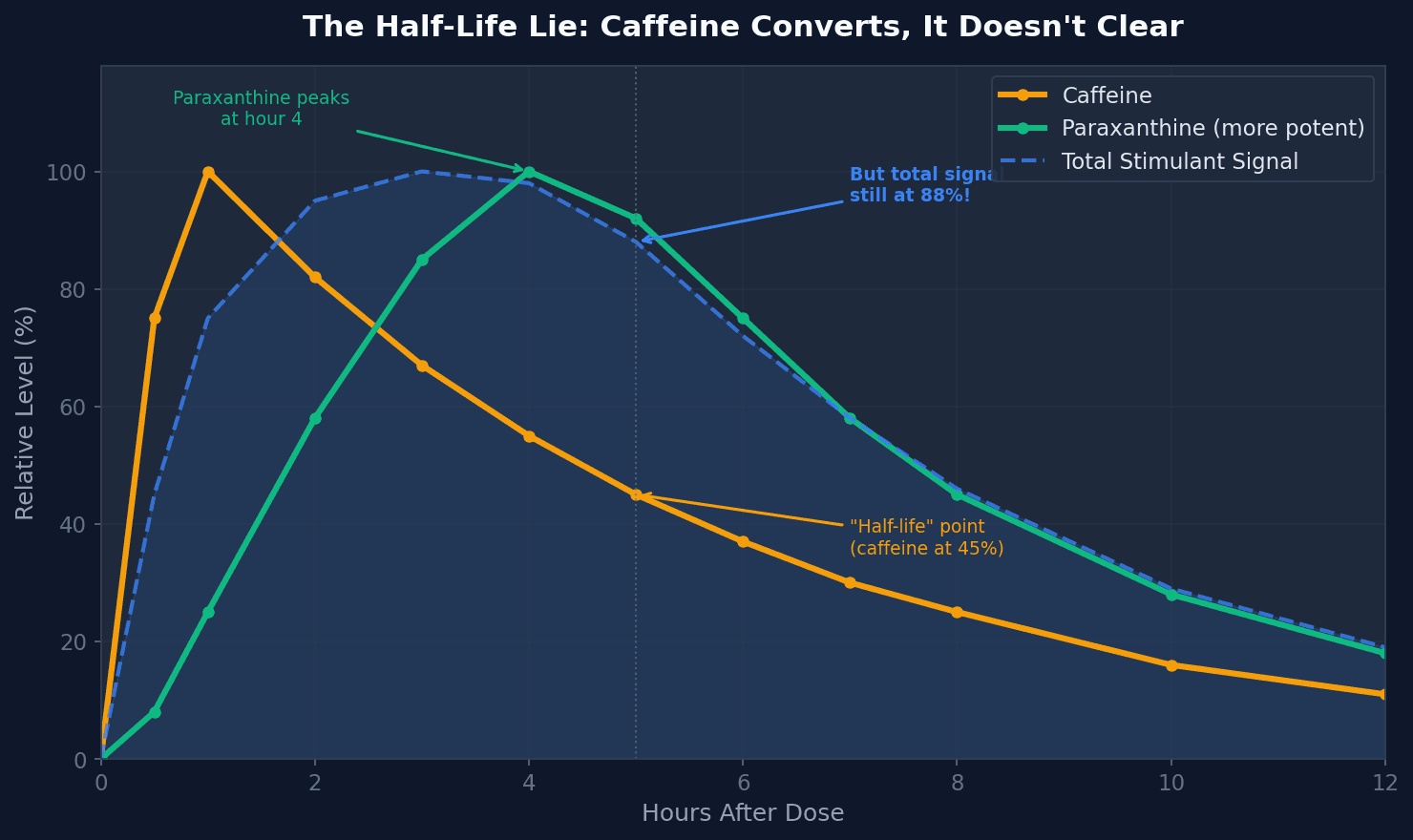
Look at the shape:
- Caffeine (orange) peaks at ~1 hour, then declines
- Paraxanthine (green) rises slowly, peaks at ~4 hours
- Total stimulation (blue) stays elevated much longer than caffeine alone would suggest
At hour 6, caffeine is at ~35% of peak. But paraxanthine is still at ~75%. And that paraxanthine is more potent per molecule than the caffeine was.
This is why "caffeine's half-life is 5 hours" is so misleading. The half-life of the parent molecule is 5 hours. The half-life of the stimulant signal is much longer.
The Bedtime Problem: Residual Stimulant Load
Now let's do the math for a 3pm coffee with an 11pm bedtime—8 hours later.
Caffeine:
- 8 hours = roughly 2 half-lives
- 100% → 50% → 25% remaining
- But wait: you've also generated paraxanthine, which peaked around 7pm
Paraxanthine (generated from caffeine):
- Peaks ~4 hours after caffeine intake (7pm)
- At 11pm, that's 4 hours after peak
- 4 hours ÷ 3.1 hour half-life ≈ 1.3 half-lives
- Still ~40% of peak paraxanthine levels
Plus theophylline (7.2h half-life) and theobromine (6.2h half-life), which are barely diminished.
Here's the comparison at each time point:
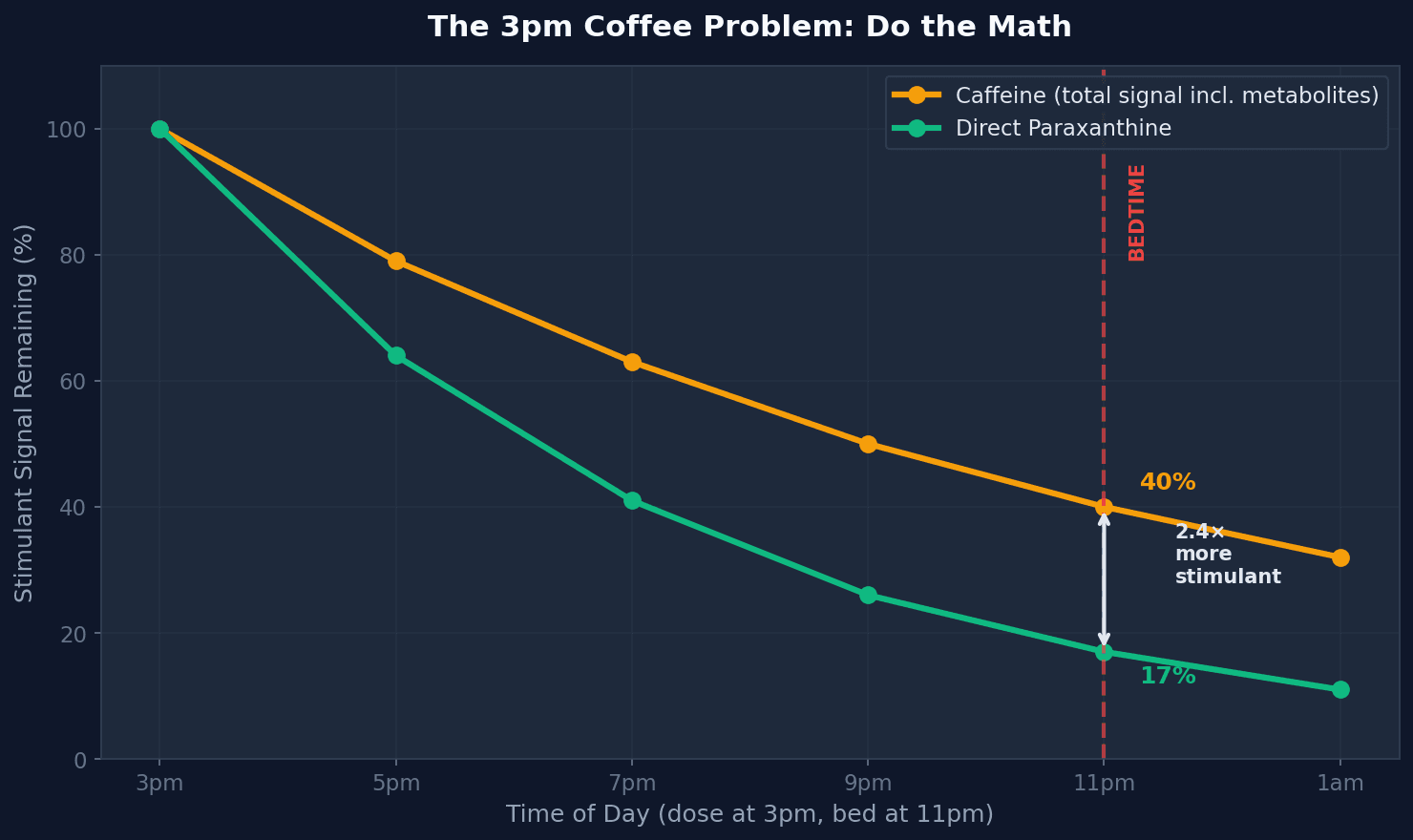
At 11pm:
- Taking caffeine at 3pm → ~40% stimulant load remaining
- Taking paraxanthine at 3pm → ~17% remaining
That's not a small difference. Caffeine leaves 2.4× more stimulant in your system at bedtime.
And remember: with caffeine, that remaining 40% includes theophylline and theobromine—compounds with 6-7 hour half-lives that will persist well into your sleep.
Why Direct Paraxanthine Is Cleaner
When you take paraxanthine directly, you skip the entire metabolic relay:
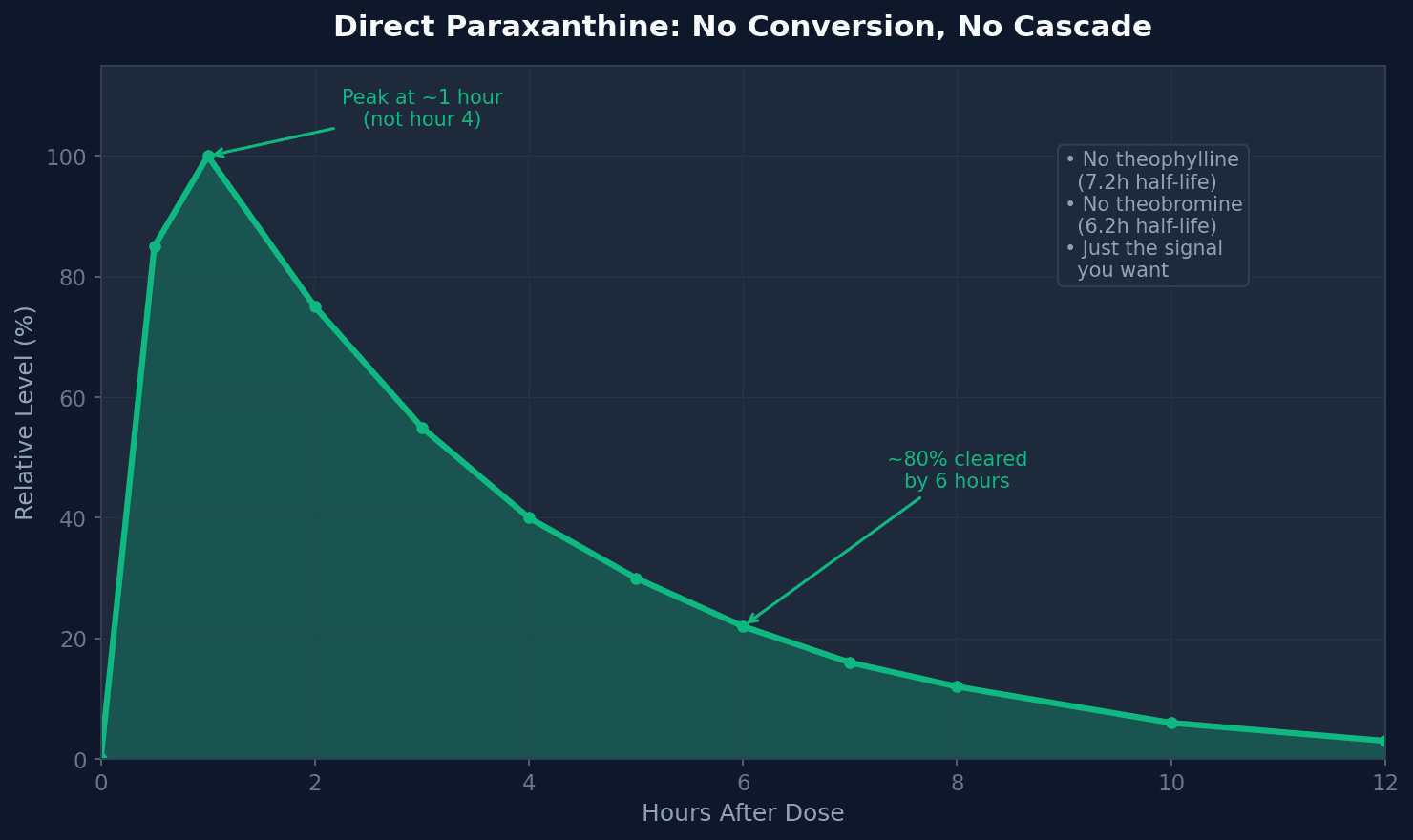
The difference is structural:
- No conversion delay: Paraxanthine is already the active compound. Peak at ~1 hour, not ~4 hours.
- No metabolite cascade: You don't generate theophylline (7.2h half-life) or theobromine (6.2h half-life).
- Shorter half-life: 3.1 hours vs. caffeine's 4.1 hours—25% faster clearance.
- Dual enzyme pathways: Paraxanthine is metabolized by both CYP1A2 and CYP2A6, reducing bottleneck risk.
The result: a compressed, predictable signal. Earlier peak, cleaner decline, minimal residual at bedtime.
The Timing Comparison
Based on the half-life math, here's how sleep disruption risk changes by dose timing (assuming 11pm bedtime):
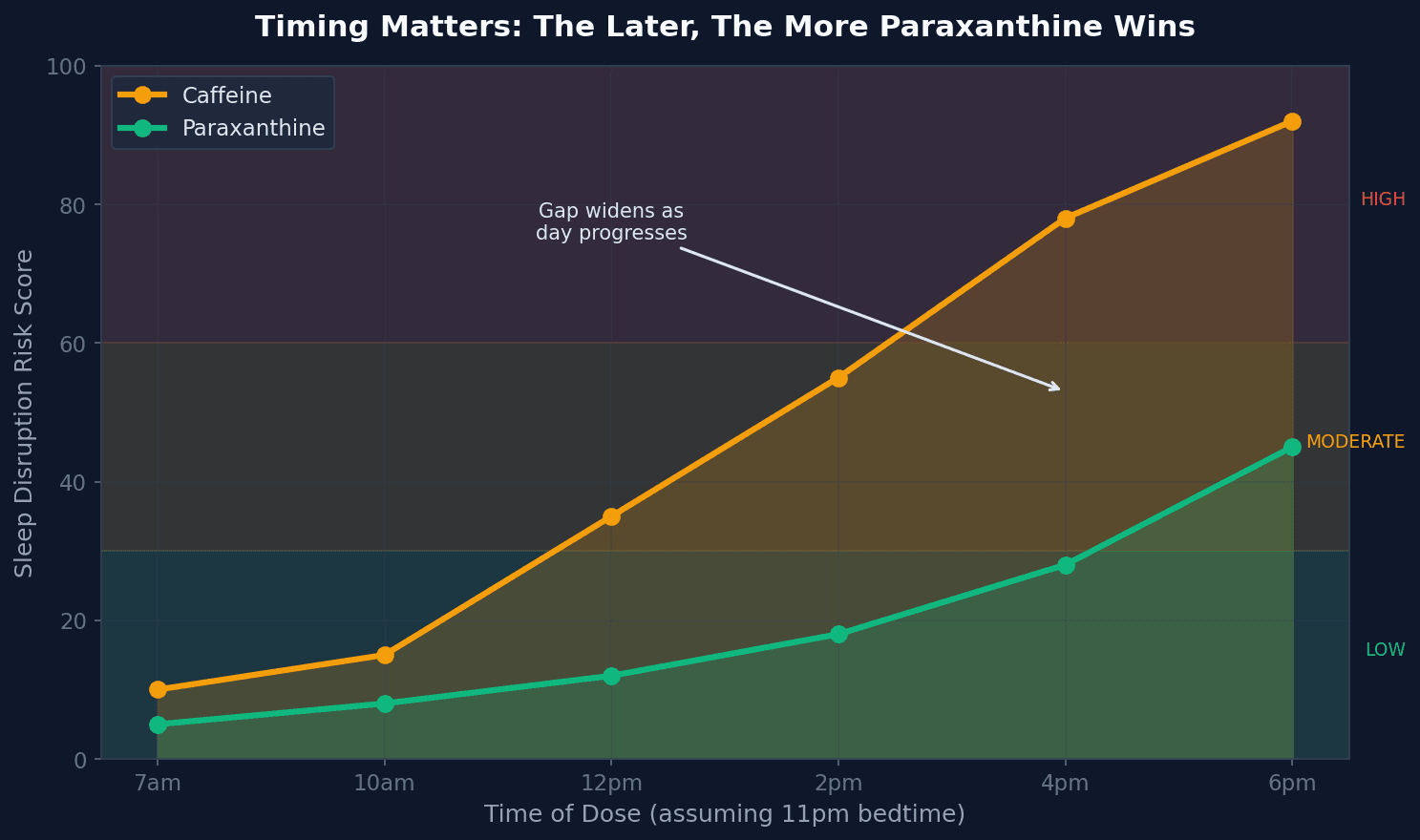
| Time | Caffeine | Paraxanthine |
|---|---|---|
| 7am | ✓ Low risk—16 hours to clear | ✓ Very low risk |
| 12pm | ⚠️ Paraxanthine peaks at 4pm, still elevated at 11pm | ✓ Clean by evening |
| 3pm | ❌ Paraxanthine peaks at 7pm, 40% at bedtime | ⚠️ 17% at bedtime—manageable for most |
| 6pm | ❌ Paraxanthine peaks at 10pm, major sleep disruption | ⚠️ Still risky but shorter tail |
The gap widens as the day progresses. In the morning, both compounds are fine. By afternoon, paraxanthine's cleaner kinetics become increasingly advantageous.
The Research Confirms the Math
The pharmacokinetic math predicts that caffeine should substantially impair sleep even when taken many hours before bed. The research confirms exactly this:
Drake et al. (2013) at Henry Ford Hospital gave subjects 400mg caffeine at 0, 3, and 6 hours before bedtime. Even at 6 hours, caffeine reduced total sleep by over an hour. Notably, subjects didn't subjectively notice the disruption at 6 hours—but objective sleep monitors detected it.
This matches our model: at 6 hours, caffeine is "half gone" but paraxanthine is near peak. The stimulant signal is still high.
Gardiner et al. (2023) meta-analyzed 24 studies and found caffeine:
- Reduces total sleep time by 45 minutes
- Reduces sleep efficiency by 7%
- Reduces deep sleep (N3) by 11.4 minutes
- Increases sleep onset latency by 9 minutes
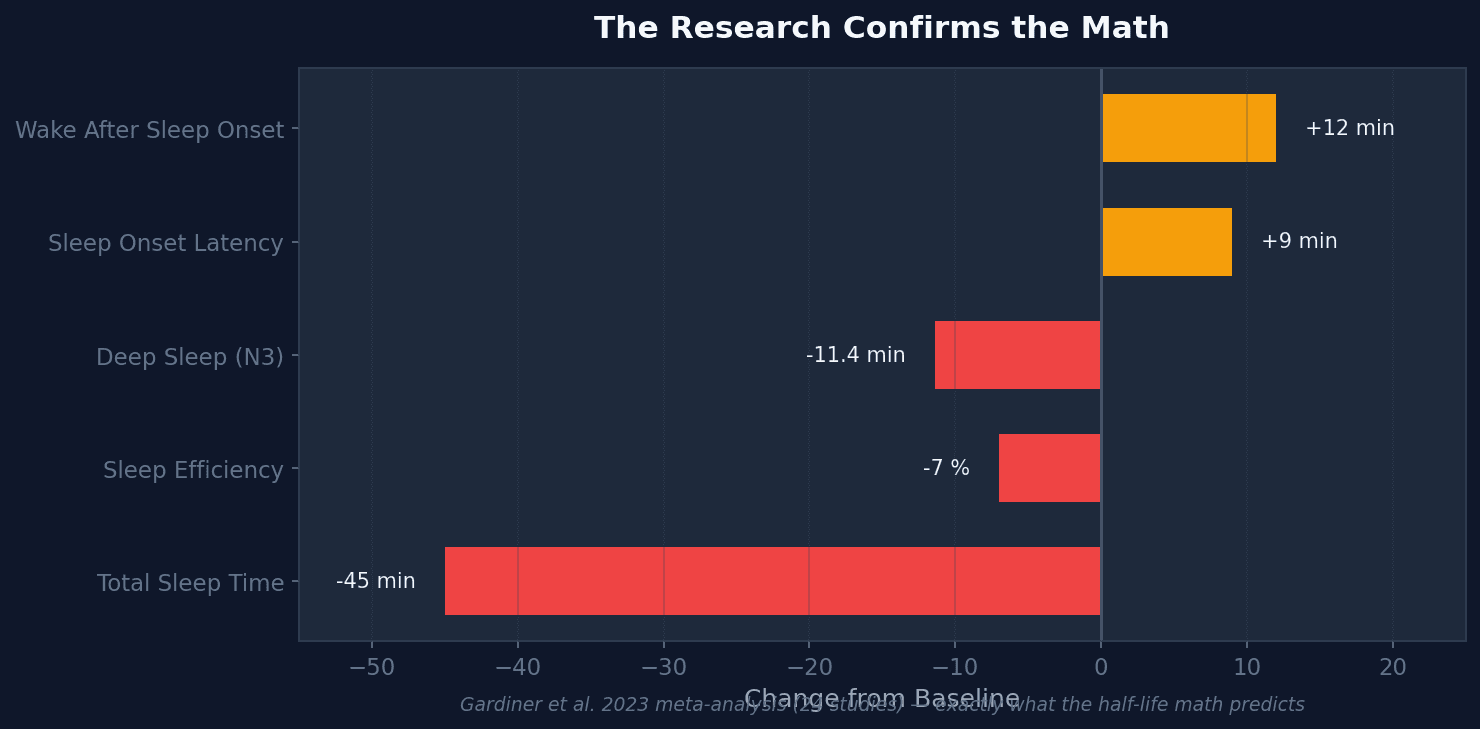
Their conclusion: to avoid sleep reduction, coffee should be consumed at least 8.8 hours before bed. For higher doses (~218mg), 13.2 hours.
Why so long? Because "caffeine clearance" isn't the same as "stimulant clearance." The metabolites extend the signal.
Gardiner et al. (2025) in a clinical trial found 400mg caffeine should be avoided within 12 hours of bedtime.
The half-life math predicted all of this. The studies just confirm it.
The Mechanism: Adenosine and Deep Sleep
Why does this matter for sleep quality, not just sleep duration?
Caffeine and paraxanthine both work by blocking adenosine receptors—primarily A1 and A2A subtypes. Adenosine is your brain's "sleepiness signal": it accumulates during waking and tells your brain it's time to sleep.
When you block adenosine receptors, you don't eliminate adenosine. You just prevent your brain from hearing the signal. The adenosine keeps building. When the stimulant finally clears, all that accumulated sleep pressure hits at once.
But the sleep architecture effect is more insidious: caffeine specifically suppresses slow-wave activity—the deep delta waves in Stage 3/4 NREM sleep. This is when your brain clears metabolic waste, consolidates memories, and releases growth hormone.
Landolt et al. (1995) showed that even 100mg caffeine at bedtime significantly reduced delta activity in the first sleep cycle.
A May 2025 study from Université de Montréal found caffeine increases brain signal "complexity" during sleep—keeping the brain in a more alert, less restorative state even when you're technically asleep. You're not just sleeping less. You're sleeping worse.
Why Caffeine Feels "Edgier"
Beyond timing, there's a qualitative difference. Caffeine produces more peripheral effects than paraxanthine:
- More PDE inhibition → higher cAMP → adrenaline-type response
- More adrenal medulla activation
- Broader sympathetic nervous system engagement
This translates to: jitters, elevated heart rate, anxiety in susceptible people.
A Stanford sleep lab study (Okuro et al. 2010) found paraxanthine has "higher potency at A1 and A2 receptors, but lower toxicity and lesser anxiogenic effects than caffeine." The wake-promoting effect was greater and longer-lasting than equimolar caffeine, without the side effects seen at high caffeine doses.
Paraxanthine is more CNS-selective: alertness without the fight-or-flight overlay. The "clean focus" that caffeine sometimes delivers is largely the paraxanthine signal—contaminated by caffeine's peripheral effects.
The Variability Problem
Because caffeine must be converted to paraxanthine via CYP1A2, individual variation is enormous:
- Genetics: CYP1A2 polymorphisms create "fast" and "slow" metabolizers
- Smoking: Induces CYP1A2, speeding metabolism
- Oral contraceptives: Inhibit CYP1A2, slowing metabolism
- Pregnancy: Caffeine half-life doubles
- Medications: Many drug interactions
A study of competitive cyclists found slow metabolizers experienced 13.7% worse performance after caffeine vs. placebo—while fast metabolizers improved 6.8%. Slow metabolizers also have elevated cardiovascular risk with regular caffeine use.
Direct paraxanthine bypasses this. It's metabolized by two enzyme pathways (CYP1A2 and CYP2A6), and CYP2A6 polymorphism is rare. The dose you take is closer to the dose you feel.
Why I Prefer Paraxanthine
Paraxanthine delivers:
- Equivalent or stronger alertness (higher A2A potency)
- Less sympathetic activation (fewer jitters, less anxiety)
- Shorter, predictable duration (3.1h vs 4.1h+ half-life)
- No long-tail metabolites (no theophylline/theobromine)
- Much better sleep compatibility (17% vs 40% residual at bedtime)
Caffeine isn't "bad." But it's a noisy delivery mechanism for what is, pharmacologically, a cleaner stimulant.
Once you see caffeine as a paraxanthine delivery system with side effects, choosing the metabolite directly becomes obvious—especially if you care about sleep.
The Bottom Line
The often-quoted "caffeine has a 5-6 hour half-life" makes it sound manageable. It isn't.
-
That half-life describes conversion, not elimination. Caffeine becomes paraxanthine, which is more potent and has its own half-life.
-
The stimulant signal peaks later than caffeine. Paraxanthine peaks at ~4 hours, meaning your 2pm coffee is maximally stimulating around 6pm.
-
Multiple metabolites extend the tail. Theophylline (7.2h) and theobromine (6.2h) persist well past midnight.
-
Direct paraxanthine compresses the signal. Faster peak, cleaner decline, 25% shorter half-life, no metabolite cascade.
-
The math predicts exactly what the studies show. Caffeine disrupts sleep for 8-12+ hours. The pharmacokinetics explain why.
If caffeine feels great in the morning but terrible later—or if you can't drink coffee past noon without lying awake—this isn't willpower or sensitivity. It's pharmacology.
And now there's a way around it.
Key References:
- Drake et al. (2013). Caffeine effects on sleep taken 0, 3, or 6 hours before going to bed. J Clin Sleep Med.
- Gardiner et al. (2023). The effect of caffeine on subsequent sleep: A systematic review and meta-analysis. Sleep Med Rev.
- Gardiner et al. (2025). Dose and timing effects of caffeine on subsequent sleep. SLEEP.
- Okuro et al. (2010). Effects of paraxanthine and caffeine on sleep in narcoleptic mice. SLEEP.
- Landolt et al. (1995). Caffeine reduces low-frequency delta activity in the human sleep EEG. Neuropsychopharmacology.
- Lelo et al. (1986). Comparative pharmacokinetics of caffeine and its primary metabolites.
Individual variation is significant. This is not medical advice.
Flashcards Available
This post includes 5 flashcards for spaced repetition. Download the deck to import into Anki.
How to import into Anki
- Download the .txt file above
- Open Anki and click Import
- Select the downloaded file
- Choose Basic card type
- Ensure fields map to Front and Back
- Click Import